Multi-Core Fiber & SDM: The Optical Infrastructure for the AI Datacenter Era

The rapid growth of cloud, video, and especially AI workloads is pushing conventional optical infrastructure toward its capacity limits. Several studies show that single-mode fiber has nearly exhausted familiar modulation dimensions such as amplitude, frequency, and polarization; the only remaining dimension with significant scalability is space. This is why Space-Division Multiplexing (SDM) and Multi-Core Fiber (MCF) are emerging as strategic directions for next-generation backbone and datacenter networks.

Source: ntt-review
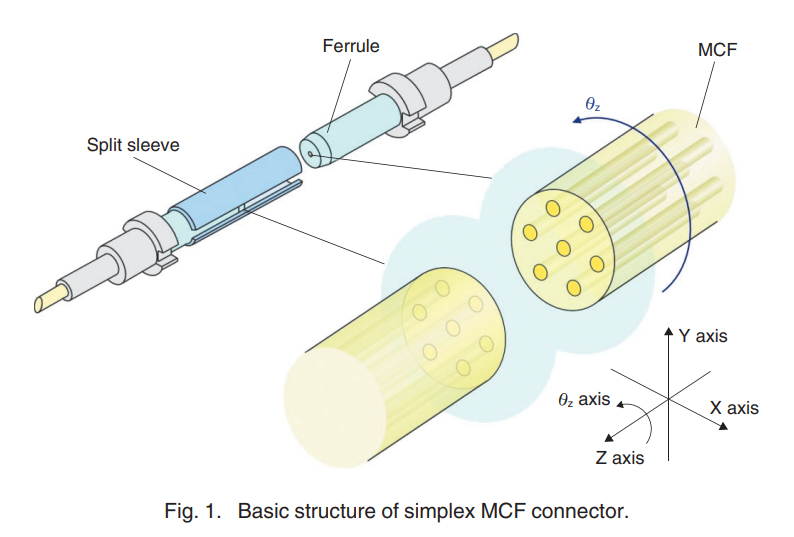
SDM enables multiple independent optical channels to travel in parallel within the same fiber—either through multiple cores (MCF) or multiple modes (FMF/MMF). Among these, MCF is considered the most practical near-term candidate because it retains the standard 125 μm cladding diameter while integrating 4, 7, 12, or even 19 cores in a single fiber. This allows dramatic capacity per-fiber scaling without multiplying the physical cable footprint in conduits, trays, or ducts inside datacenters.
Recent technical breakthroughs indicate that SDM/MCF has moved far beyond laboratory proofs. In 2023, NICT demonstrated over 1 petabit/s transmission across 1,808 km in a standard-diameter 19-core fiber, using amplification and relay systems fully compatible with MCF. Other trials achieved 400 Tb/s on a 7,000 km subsea-grade 12-core MCF, exceeding previous records by more than 30%. Market analyses summarizing SDM performance estimations suggest that SDM (with MCF as the anchor technology) could ultimately deliver 10–100× capacity improvements compared to conventional systems.
Standardization is also advancing. ITU-T has introduced SDM fiber frameworks—especially for weakly-coupled MCF—defining parameters such as diameter, attenuation, crosstalk, operational characteristics, and field-deployment guidelines. Concurrently, recent technical surveys classify SDM/MCF as a candidate backbone for ultra-high-capacity transmission across terrestrial backbones, subsea cables, and hyperscale data centres.
Market signals reinforce the trend. Several forecasts expect the global MCF market to grow significantly beyond 2030 as 4-core and 7-core fibers become common, while 12-core and 19-core fibers transition from “demo” to real-world pilots. Adjacent segments—such as fan-in/fan-out devices and multi-core connectors—are projected to reach hundreds of millions of dollars, with CAGR estimates around 7–10%. These forecasts indicate that SDM/MCF is positioned to become a foundational infrastructure layer after 2030, not just a research topic.
Within datacenters, concrete applications are already emerging. STL introduced an indoor unitube MCF cable at Connected Britain 2025, targeting high-density in-building and edge/datacenter environments. Earlier, STL and C-DOT deployed India’s first quantum-secured network over 100 km of 4-core MCF, proving that MCF can combine high bandwidth with QKD-based security. Another research group proposed a “quantum-secured DSP-lite transmission architecture” for AI-driven datacenters, positioning low-loss, low-crosstalk MCF as the foundation for energy-efficient and eavesdropping-resistant DCI links.
In summary, the SDM/MCF landscape is evolving rapidly—from laboratory concepts to serious candidates for hyperscale datacenter infrastructure: petabit-scale long-haul demonstrations, ITU-T standardization, clear market momentum, and practical demos such as indoor MCF cables and quantum-secured networks. For investors and datacenter operators, the next 5–10 years may represent the ideal window to pilot and validate a new generation of optical cabling—where each fiber contains multiple parallel lanes optimized for bandwidth, energy efficiency, and security.
Source: Nature; Industry Research; Datantelo


Comments